
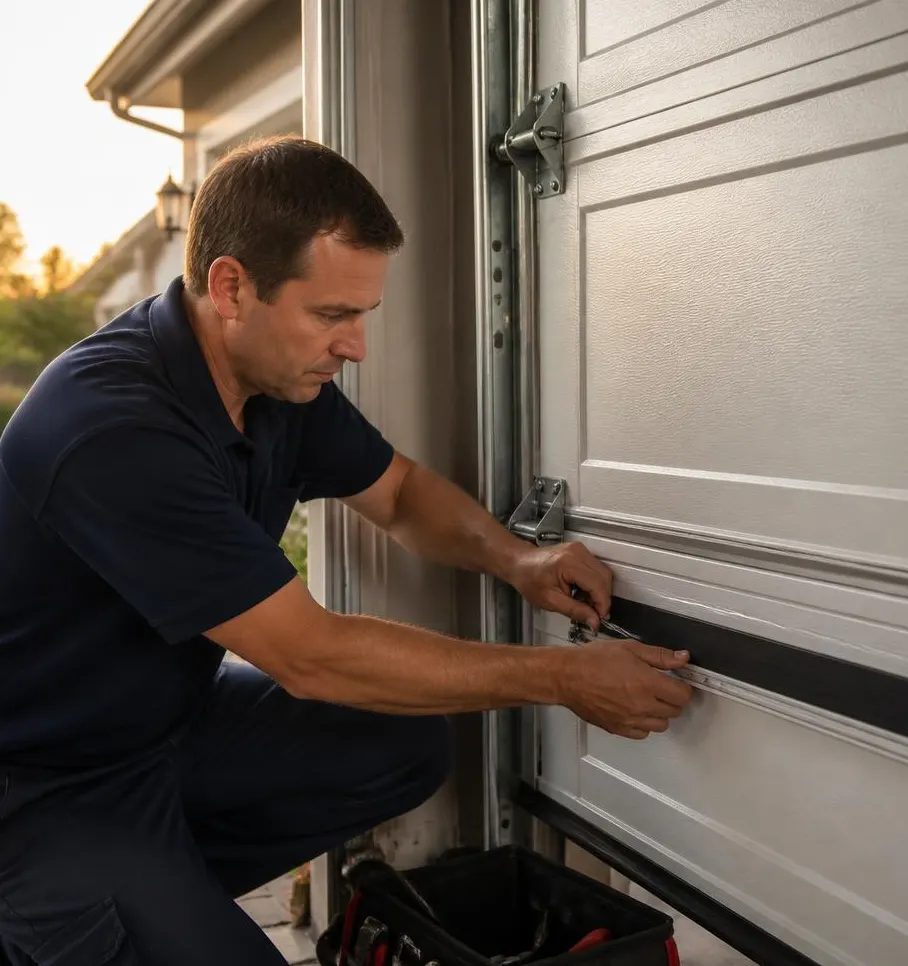
The Mistake Almost Everyone Makes First
Somebody backs a bike, a cooler, or the corner of a trailer hitch into the garage door, and within ten minutes someone has pulled up a video showing how to pop a dent out with a plunger, a hair dryer, or a shop vac. It's tempting because it genuinely works on a car fender. A car panel is thin sheet metal over open air, held in place by nothing but its own shape. A garage door panel is a different animal: it's often backed by foam insulation, sometimes reinforced with steel stiffener bars, and it's bolted to hinges that have to line up with rollers and a track. Pulling or pushing on it with suction can flex the metal in ways that crack the paint seal, separate the foam backing, or tweak the hinge mounting holes just enough that the door starts binding. So the first mistake is treating a garage door panel like a car door. The second, equally common mistake is the opposite extreme: assuming any visible dent means the whole door is junk and needs full replacement. Neither assumption is right, and the real answer depends on where the dent is and how deep it goes.
Three Questions That Settle the Argument
1. Is it in the flat field of the panel, or near a hinge/track edge?
A shallow dent in the middle of a panel, away from the hinges and the edge where rollers ride, is almost always cosmetic. It doesn't affect how the door opens, closes, or seals. A dent within a few inches of a hinge or the vertical edge of a panel is a different story — that's exactly where the door needs to stay true to keep rollers tracking straight.
2. Does the door still move smoothly through a full cycle?
Run the door up and down (by hand with the opener disconnected, if you can do that safely) and watch the rollers. If they ride the track cleanly the whole way, the dent hasn't touched the door's structure. If you see the rollers chatter, bind, or pop slightly out of the track near the damaged spot, the dent has bent the panel enough to distort its shape — that's a mechanical problem, not just an appearance problem.
3. Is the metal creased, or just pushed in?
A smooth, rounded dent means the metal stretched and can often be filled, sanded, and repainted like a wall patch. A sharp crease or fold means the metal's grain has been broken at that line. Creased steel wants to flex at that crease every time the door moves, which is how a small cosmetic dent slowly turns into a crack.
When It's Cosmetic — And When It's Structural
Cosmetic dents: shallow, rounded, centered in the panel field, door still tracks and seals normally. These can usually be repaired in place — body filler and matching paint for steel doors, or a panel swap if you want a cleaner finish.
Structural dents: anything that's creased, anything within a few inches of a hinge, roller bracket, or the top/bottom seal, or anything where the door no longer glides evenly. These need more than cosmetic work because a distorted panel changes the geometry the whole door relies on — hinges that no longer sit flat, rollers forced at a slight angle, a bottom seal that no longer meets the slab evenly and lets in wind-driven rain.
That last point matters more here than in drier climates. A dented spot where the paint has cracked is a direct invitation for salt air and humidity to get under the coating and start rust from the inside out — and on the Nature Coast, that process moves fast. A dent that seems purely cosmetic in July can be a rust bubble by hurricane season if it's never sealed back up. If your door is rated for wind load, a bent or weakened panel can also undercut the reinforcement that rating depends on, which isn't something you want to find out mid-storm.
What Repair Actually Looks Like
- Minor cosmetic dent: filler, sanding, and touch-up paint matched to the panel color — usually inexpensive, done in place.
- Dent with a crack or exposed metal: that section needs to be sealed and primed immediately to stop rust, even if full repair comes later.
- Single damaged panel on a sectional door: often doesn't require replacing the whole door — just that one panel, matched to the rest.
- Dent near hinges or rollers with binding: needs the hardware checked and possibly realigned along with the panel repair, not just a cosmetic fix.
When to Call Aripeka Overhead Door Co
If the door is binding, the rollers are chattering, or the dent is creased and close to a hinge, that's past a DIY paint job. We can tell you honestly whether it's a straightforward Garage Door Panel Replacement or whether the dent has knocked the door enough out of true that it needs Off Track Door Repair to get rollers and hinges back in alignment before anything cosmetic gets touched. We'll also check the affected section for early rust before it spreads under the paint.
If you're in Aripeka, Hudson, New Port Richey, Spring Hill, or anywhere else along the Nature Coast and you're staring at a dent trying to decide who's right, give us a call — we'll come look at it in person and tell you straight whether it's a patch job or something more.